
The drive to Austin wasn’t as bad as I thought it would be regarding stopping and charging. All the super-chargers at all the Buc-ee’s on I-35 made it pretty easy. There’s a little range anxiety driving there because you know you have to drive back. However, driving back was a cinch. Because the parking garage where I interviewed had car chargers, I was able to leave Austin with a full charge. So I only had to stop once to charge, which I would have done anyway for a restroom break and to stretch my legs. That charge was less than 25-minutes and cost under five bucks. It turns out that not renting a car was a good thing, and I might drive to places like Austin more often.
Traffic stunk on the way there, but was great on the way back; though I was surprised by the number of law enforcement I passed trying to catch speeders. I counted at least seven on the way home.
It’s always unsettling seeing the Confederate flag flying high off I-35 while driving through Waco.
It was fun having the dogs along for the ride and to keep me company. They really enjoyed the attention they received when we took a stroll on the University of Texas campus.
I typically don’t like talking about how my interview went. It’s a silly superstition that I might jinx myself. But I guess I feel comfortable saying it was solid. I guess there was a certain relief about having an in-person interview, even if I had to drive four hours, as opposed to yet another AI-interviewing tool or video conference.
I appreciated the interview’s format. After I was escorted into a conference room, I was given a project schedule and outline to study for five-minutes. Then a small panel of folks walked in for introductions. I was then given four pages of questions. I was told they would read each one aloud. I could take some time to think about a response, without having to answer immediately. Having a visual and being able to reference something was helpful, and I wrote notes as each was read. Most were scenario-based, and only one was the typical “give me an example when” variety. In all, the interview lasted about 70 minutes, and I felt I had a good rapport or chemistry with the team.
Even if I don’t get this job, unlike most interviews I’ve had during this drought, I felt there were lessons I could take away. That I had something to build on. It was also the first time I felt like I wasn’t being tested but being treated as a consultant. I guess I felt like I was on offense this time and not on defense. That is, when each item was read to me, my concern wasn’t how they would grade my answer. Instead, I felt like I was identifying the need, want, or problem, and then telling them the best way to accomplish it.
Speaking of lessons learned, yesterday marked the five-year anniversary of when the person I was married to decided to break apart our family.
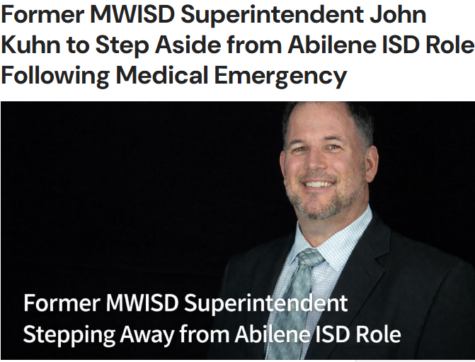
I was surprised to learn that Abilene ISD’s (former) superintendent last worked as Mineral Well’s superintendent. He recently stepped down wrinting the following:
On December 30, 2025, I suffered a serious heart attack – a “widowmaker,” with 100% blockage of my left anterior descending (LAD) artery and 80% blockage of my circumflex. Thankfully, I was at home at the time; my wife and children called 911 and acted quickly to treat me with aspirin.
Regarding the Nancy Guthrie kidnapping, I predict a future news article about the increase in sales of Ozark Trail Hiker Pack backpacks.
I didn’t think the gondola rides at Las Colinas were still operating, let alone popular.
Often privy to multiple marriage proposals a day, the gondola king of Irving has learned a thing or two about the affairs of the heart. 🚣💕 https://www.texasmonthly.com/being-texan/irving-las-colinas-gondoliers-love-advice/
— Texas Monthly (@texasmonthly.bsky.social) February 11, 2026 at 4:00 PM
🥇🥇🥇
— George Conway ⚖️🇺🇸 (@gtconway.bsky.social) February 10, 2026 at 7:06 AM
Cartoons are real. pic.twitter.com/iCfj9Qnxzm
— The Figen (@TheFigen_) February 11, 2026
New combat sport league where heavyweights just sprint full speed into each other pic.twitter.com/KhMfUYWlUn
— Happy Punch (@HappyPunch) February 7, 2026
My next interview will be with the National Institutes of Health (NIH). Thankfully, I already have my Public Trust security clearance, which is valid through April 2029. The description, if you are interested, is after the jump.
Senior Business Analyst supporting the National Heart, Lung, and Blood Institute (NHLBI) at National Institutes of Health (NIH).As a Senior Business Analyst you will help ensure today is safe and tomorrow is smarter. Our work depends on Senior Business Analyst joining our team to support development of new MSPP applications, as well as modernizing existing applications for our customers, which will support their administrative and research activities including those related to planning, funding, and conducting research that promotes the prevention and treatment of heart, lung, and blood diseases.
How a Senior Business Analyst will Make an Impact: